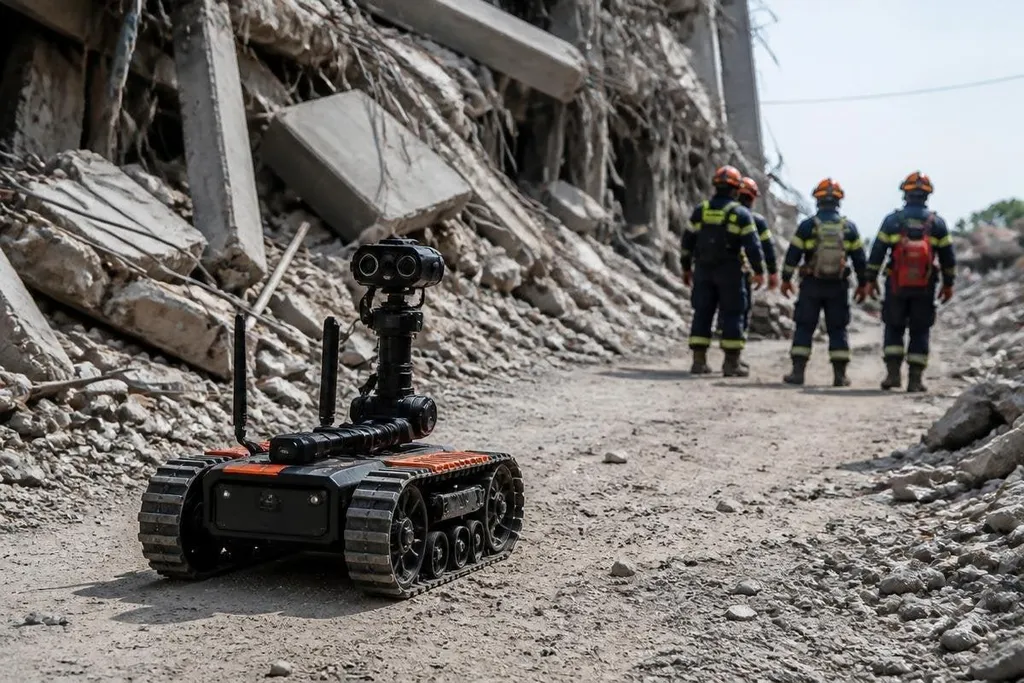
Rescue robots earn attention when they find people, carry useful gear, or keep working where crews face danger. The next systems to watch are those that cut search time without adding another machine for rescuers to manage.
- Search: thermal cameras and mapping that help crews check damaged spaces faster
- Access: small tracked or walking robots that reach narrow, unstable areas
- Support: drones and ground robots that carry radios, lights, sensors, or medical supplies
Search that gives rescuers a better map
A robot with a camera can send video from a space too risky for a person. That matters when a building may collapse, smoke blocks sight, or a tunnel has poor air. Video alone has limits, so the useful step is joining images with a map and the robot’s position.
Thermal imaging can show heat that a normal camera misses. It can also confuse hot pipes, fires, and damaged equipment with a person. The rescue system needs clear images, location data, and a way for a crew member to check the finding before anyone enters.
The proof should come from a named trial. Look for the site type, search area, number of finds, time taken, and false alarms. A polished demonstration tells you how the robot moves. It doesn’t tell you how often the crew gets the right answer.
For a rescue team comparing machines, rescue robotics reporting from Robot24.com can tie a claim to the test site, search area, number of finds, time taken, and false alarms. Those details matter most when a robot has to enter a place people can’t safely reach.
Robots that reach places people can’t
Small tracked robots can pass under gaps and across broken floors. Walking robots may handle steps or loose ground, but their feet, motors, and sensors face more ways to fail. The useful question is the same for both designs: can the robot reach the search point, send data back, and return?
Remote control remains a practical part of this work. A teleoperator means a person sends commands while the robot carries the camera and sensors. Control software can reduce the number of commands needed, but it still needs a clear radio link and a trained operator.
Signal loss is a rescue problem, not a footnote. Walls, metal, dust, and distance can block radio traffic. A serious test should state the range, delay, backup link, and what the robot does after contact drops.
Machines that carry help
One rescue robot may do more useful work by carrying equipment than by acting on its own.
A drone can bring a radio or light to a high point. A ground robot can carry a camera, air sensor, or small medical pack across ground that a person should avoid.
Payload tells only part of the story. Teams also need the travel time, battery life, setup steps, weather limits, and return route. A robot that carries 10 kg for 20 minutes may fit one task and fail another that needs an hour in the field.
Autonomy can reduce operator workload when the robot follows a mapped route or holds a safe position. It should not remove human checks around injured people, unstable structures, or uncertain sensor readings. Those tasks need clear handover rules and a way to stop the robot at once.
A practical watch list
Use these checks when a rescue robot moves from a video to a purchase discussion:
- Named test site: Find the location, hazard type, and date of the trial.
- Measured result: Ask for search time, distance, payload, battery duration, or detection rate.
- Human workload: Check how many operators were needed and what training they had.
- Lost-link behavior: Confirm whether the robot stops, returns, or keeps moving after contact fails.
- Service plan: Check who replaces batteries, sensors, tracks, legs, and radio parts.
- Purchase terms: Ask for the robot price, control hardware, training, repairs, and software fees.
I'd skip any rescue robot whose main proof is a staged video with no test method or field result.
The systems worth watching will have named crews, measured tasks, and failure reports beside the successful runs. Until those details appear, treat the machine as a tool to test, not a rescue answer to buy.